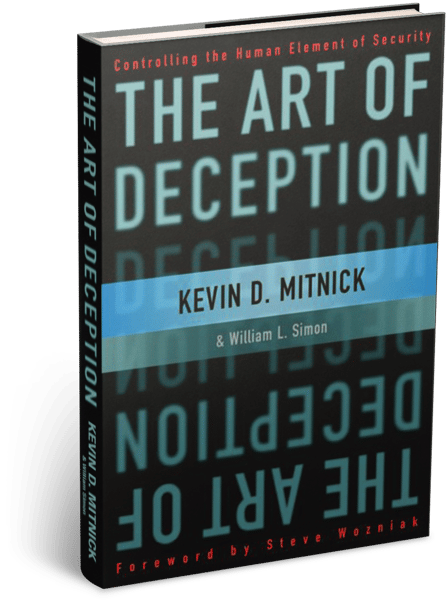
Kevin Mitnick’s ‘The Art of Deception’ is a deep dive into the world of social engineering, far beyond the clumsy phishing attempts filling our inboxes. Before picking up this book, my idea of a social engineer was pretty one-dimensional — malicious actors crafting phishing emails, or even the one rogue actor who might try sneak into a company building in an obvious way. But Mitnick, one of the most infamous hackers of the 1990s, turns that image on its head. He unpacks the many manipulative tactics that social engineers can use to infiltrate their way into organisations, preying on the weakest link of any security operation – the human element. Even with the most sophisticated tech in our modern technological age, if the people around us don’t remain vigilant, Mitnick tactfully demonstrates just how easily social engineers can break in undetected.
Delving into Mitnick’s accounts, I came to understand that cybersecurity isn’t just about the secure technologies we use; it’s about the bigger picture of security. It encompasses both the digital defences and the human elements that play a crucial role in protecting information, with both being of equal importance. His stories, while some may hinge on outdated tech like telephone switchboards, are timeless in their lessons. They taught me that vigilance is key and that the most innocuous details can be twisted into a tool for deceit. Information that may seem harmless to you, may be the key a social engineer needs to manipulate his way into your organisation. Throughout the various anecdotes Mitnick provides, it allowed me to become more cautious and critical of the information I give out and whom I trust — a mindset shift that’s sure to stick with me throughout my career going forward now.
Mitnick’s book shines with its detailed breakdown of social engineering tactics, painting a vivid picture from both the perpetrator’s and the victim’s perspectives. Each chapter follows a similar style that presents each social engineering tactic in an engaging way. Mitnick fills each chapter with multiple vignettes of each ‘con’, exploring its execution from the victim and social engineer’s point of view, before analysing its execution and prevention. Providing both the perspectives of the social engineer and the victim really cements the realism of each story, which allowed me to really grasp just how easily an attack like this could occur unnoticed. Each chapter is rich with detail, and Mitnick follows this up by providing a comprehensive list of security policies and measures to combat all the different attacks he explores throughout the book. Despite being written for a different technological era, this section may provide the best value for many people as Mitnick clearly was extremely thorough in his suite of recommendations.
While Mitnick’s work is rich in detail, I found that many of the chapters tended to slightly overstay their welcome. The later chapters start to blend into each other, and cutting down on some of the repetition could make the key points stand out more. Reducing some chapters by even one or two anecdotes would go a long way to streamlining the reading experience whilst making the key points stand out more. The lack of variety in the style of the chapters also slightly hampered my enjoyment as I read through the book, and may cause some reader’s engagement to wane. Each story within each chapter was still rich with information, but after you finish the first chapter, you soon find out the rest of the book is structured exactly the same. I would’ve liked to see some more variety in how the information is presented throughout the book, which I believe would have made the readability more enjoyable and less repetitive.
Overall, ‘The Art of Deception’ still holds up in the fast-paced world of cybersecurity as an impressively informative read decades on from its release. Mitnick’s expertise and prior experience allows him to offer a treasure trove of insights into the minds of social engineers, making it an enlightening read for anyone wishing to expand their defensive knowledge. Even with some sections that could use tightening up, the book’s core messages and the learnings it provides are both clear and powerful. I’d recommend it to anyone who wants to up their security game, if you’re willing to look past the dated technology and focus on the key aspects pertaining to the vulnerabilities of the human psychology. If you can, I know you’ll find it to be a real eye-opener and a guide that could very well save you from becoming another cautionary tale.
 The Last Cyber Bender